Chain of Custody
A first fundamental principle of AppKeyId is that communication should be as auditable as any financial transaction or legal document. To achieve this, every stage in the life of a Card is cryptographically authenticated, creating a verifiable chain of custody from author to recipient.
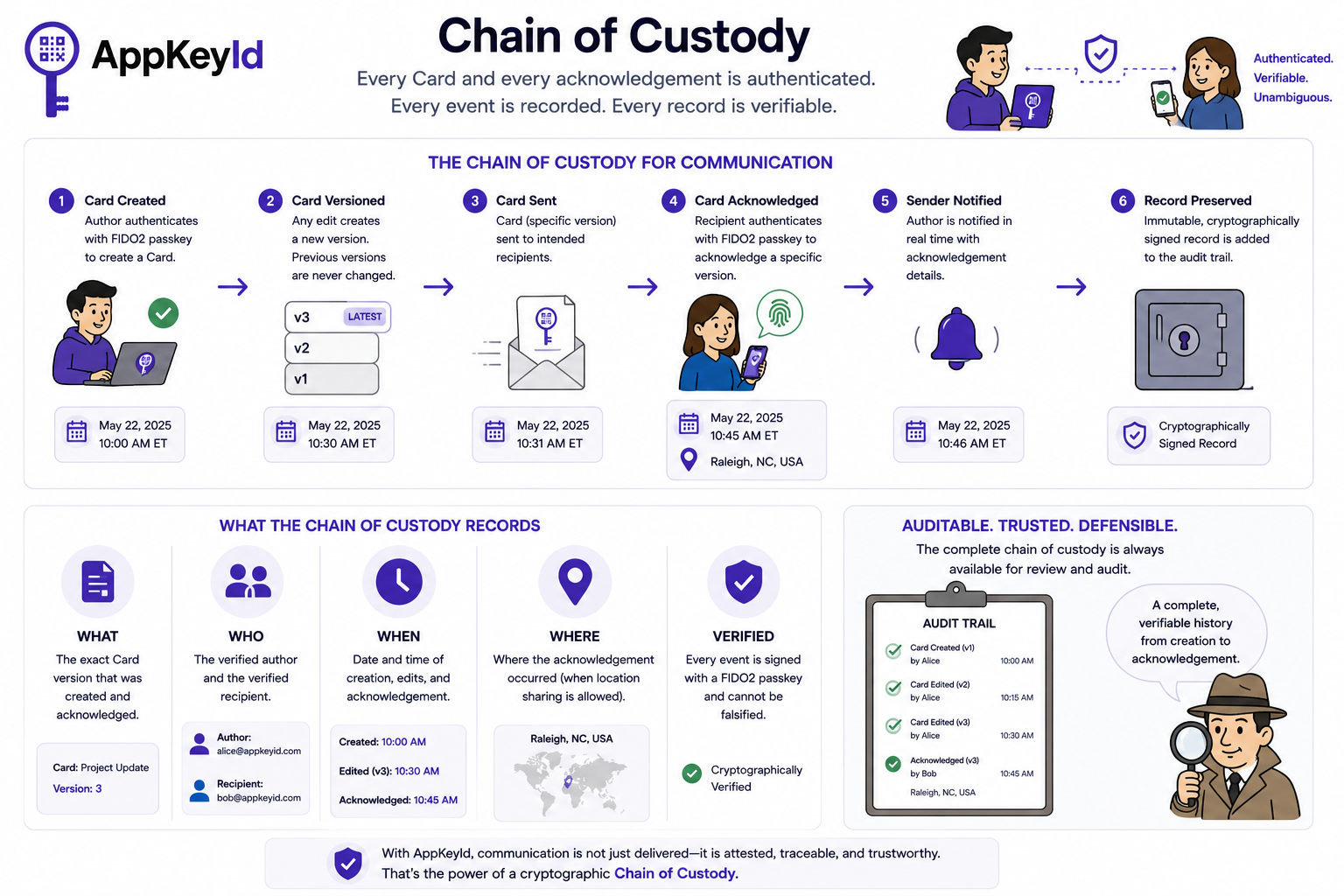
The chain begins when an author creates a Card. Before the Card is committed to the system, the author authenticates using a FIDO2 passkey. This cryptographically binds the Card to the verified identity of its creator and establishes precisely who authored the communication and when it was created.
Card Versioning
Unlike traditional messaging systems, Cards are immutable once published. If the author changes the title, content, attachments, recipients, or any other significant property, AppKeyId creates a new version of the Card rather than modifying the existing one. Each version has its own identity and its own authenticated history. Recipients never acknowledge a vague or changing document—they acknowledge a specific version of a specific Card. This eliminates ambiguity over what information was presented at the moment of acknowledgement.
Tracking Authorship and Acknowledgements
When a recipient acknowledges a Card, they must authenticate using their own FIDO2 passkey. The acknowledgement is cryptographically signed and permanently associated with the exact version of the Card that was consumed. The acknowledgement records the verified recipient, the date and time of acknowledgement, and, where permitted by the user and application, the geographic location from which the acknowledgement occurred. The result is an authenticated record of communication that cannot later be disputed without invalidating the underlying digital signatures.
Together, authenticated authorship and authenticated acknowledgement form a complete chain of custody. For every communication, AppKeyId can answer the fundamental questions:
- What was communicated? (The exact version of the Card.)
- Who authored it?
- Who acknowledged it?
- When was it created and acknowledged?
- Where was the acknowledgement made? (When location is available.)
This chain of custody is continuously preserved as Cards evolve through new versions. Every revision extends the communication history rather than replacing it, providing a complete chronological record of how the communication changed over time and who acknowledged each version.
Auditable Chain of Custody
Perhaps most importantly, the entire chain of custody is auditable. Organizations can review the complete lifecycle of a communication—from creation through every revision and every cknowledgement—using cryptographically verifiable records rather than relying on application logs or user testimony. Because every critical event is authenticated with FIDO2 passkeys, the audit trail provides substantially stronger evidence than conventional email headers, messaging logs, or server timestamps.
In regulated industries, legal proceedings, compliance reporting, project governance, healthcare, education, financial services, and enterprise workflows, this auditable chain of custody provides confidence that communications occurred exactly as recorded. It transforms digital communication from a best-effort exchange of messages into a verifiable record of authenticated human interaction.