Who Is the Person?
Who are you really?
Computers have become very good at moving information from one place to another. They have become much less reliable at proving who is actually participating in the exchange.
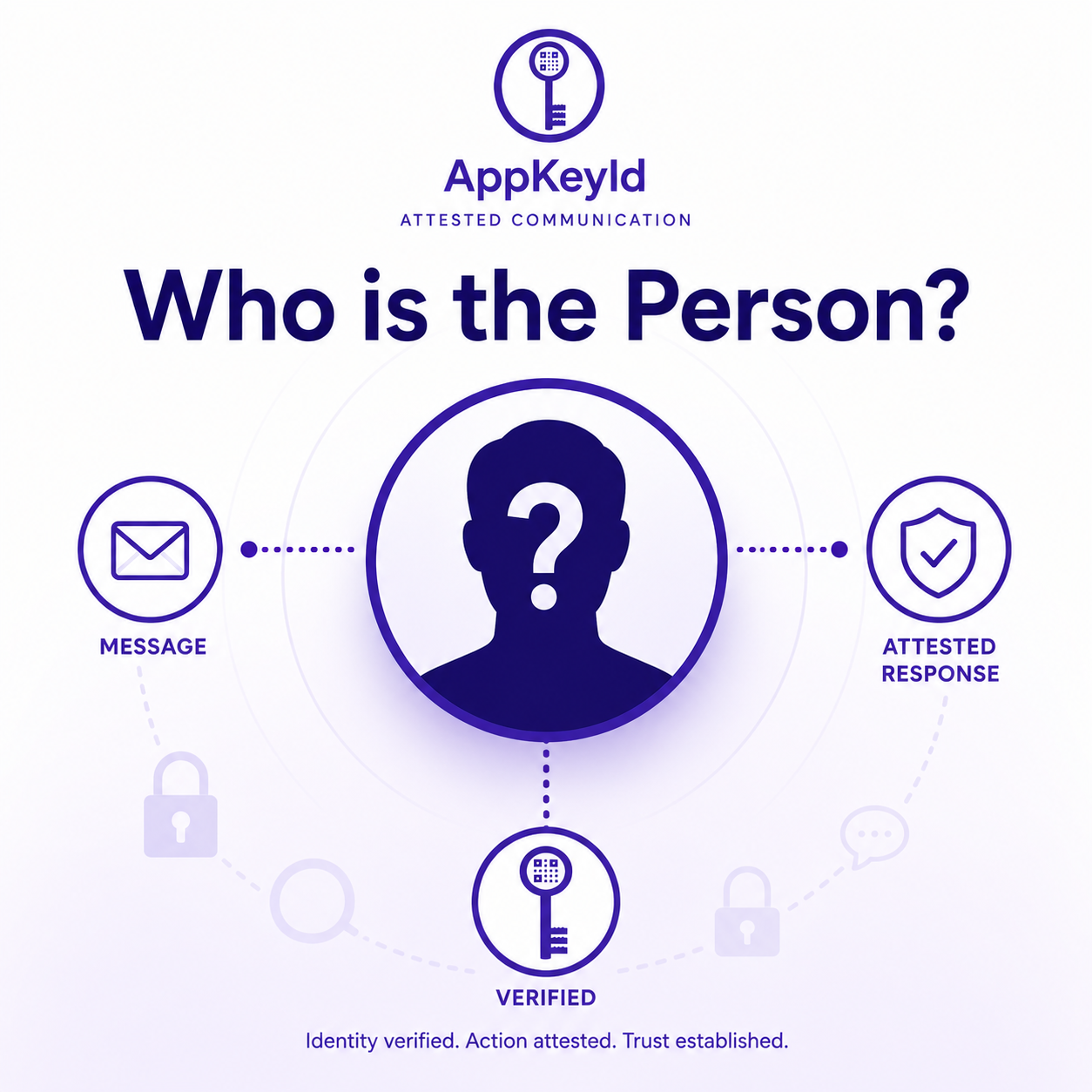
Problem of Trust
Many applications depend on knowing the identity of a person before an action can be trusted. Approving a contract, acknowledging a policy, opening a secure door, authorizing a payment, accessing medical records, or admitting someone to an event all require more than simply knowing that a message was delivered. They require knowing who performed the action, or acknowledged the communication.
Historically, this has been difficult to achieve over the Internet. Passwords identify accounts, not people. Email addresses and phone numbers can be stolen or transferred. Even two-factor authentication ultimately proves possession of a device rather than the identity of the individual using it.
Biometric authentication has existed for many years, but until recently it was largely been confined to unlocking a device. There was no widely adopted, standards-based mechanism for carrying that proof of identity across the network to another computer.
Enabling technologies
Two developments have changed this.
The first is that nearly every modern smartphone now contains secure biometric hardware. Fingerprint and facial recognition have become commonplace, and users routinely authenticate themselves with them.
The second is the adoption of the FIDO2 passkey standard. A passkey stores a private cryptographic key on the user’s device. The key never leaves the device and can only be used after the user has authenticated locally, typically through biometrics. The corresponding public key allows a remote server to verify the user’s identity without relying on passwords or shared secrets.
Together, these technologies make something practical that was previously difficult: a remote system can obtain cryptographic proof that a specific individual authorized a specific action.
This capability is what we call Attested Communication.
Attested Communication extends authentication beyond the login process. Instead of merely proving who signed into a service, it proves who created a message, acknowledged a document, approved a request, scanned a QR code, or performed another meaningful action. Every attestation is cryptographically bound to the user’s identity, the specific action, and the time at which it occurred. Optionally, additional information such as location or comments may also be recorded.
Authentication answers the question, Who logged in? Attested Communication answers the more useful question, Who performed this specific action?
New Class of Attested Applications
That distinction enables an entirely new class of applications.
Proof of Human Presence
Determine that you are communicating with a real, verified individual rather than an AI agent, impersonator, or compromised account. The recipient authenticates with a passkey before responding, providing cryptographic proof of identity.
Confidential Communication
Send a message that can only be opened by a specific verified individual. Even if the message or link is forwarded, intercepted, or copied, only the intended recipient can authenticate and access its contents.
Verified Acknowledgements
Publish a message, policy, or announcement and record exactly who acknowledged it. Instead of relying on delivery receipts or read receipts, the sender receives a verifiable list of authenticated recipients.
Group Enrollment
Allow users to securely join a team, organization, event, or mailing list by scanning an authenticated QR code or following a secure invitation. Every membership is tied to a verified identity.
Time and Attendance
Replace traditional time clocks with authenticated check-in and check-out. Each attendance record is signed by the employee’s passkey, providing an accurate and auditable record of who was present and when.
Event Tickets
Issue digital tickets that are bound to a verified individual rather than to a barcode alone. Admission requires passkey authentication, preventing ticket sharing, duplication, and impersonation.
Access Control
Grant access to buildings, equipment, restricted areas, or digital resources only after the user has authenticated. Every access event is recorded as a verified action.
Approval Workflows
Require authenticated approval of contracts, purchase orders, engineering changes, compliance documents, or safety inspections. Every approval is attributable to a specific verified individual.
Authenticated QR Codes
Transform an ordinary QR code into a secure action. Scanning the code is only the first step; the user must authenticate before the action is performed, whether that action is logging in, unlocking a door, joining a group, making a payment, or confirming delivery.
Chain of Custody
Maintain a complete, verifiable record showing who created, viewed, acknowledged, approved, or modified information throughout its lifetime. Every step is cryptographically authenticated and can be independently audited.
These applications appear different on the surface, but they all rely on the same underlying capability: the ability to associate a meaningful action with a verified human identity.
AppKeyId is a platform built around this idea. It combines FIDO2 passkeys with messages, documents, QR codes, approvals, tickets, and other communication objects so that every important interaction can be authenticated by the individual performing it. The result is a verifiable chain of communication in which identity is no longer inferred from an account or a password, but is cryptographically attested at the moment each action occurs.
The widespread adoption of passkeys marks more than the replacement of passwords. It introduces a new primitive for distributed systems: the ability to prove, cryptographically, that a particular person performed a particular action. Attested Communication is the practical application of that primitive.