Alibi Card
Alibi Cards allow an AppKeyId user to create a verifiable digital record of where they were and when they were there.
Like private Message Cards, Alibi Cards must be explicitly shared with a user before they can be acknowledged. When the user acknowledges an Alibi Card using their passkey, AppKeyId creates a permanent acknowledgement record containing the user's authenticated identity, the date and time of the acknowledgement, and, when Precise Location is enabled, the latitude and longitude reported by the user's device.
At its simplest, an Alibi Card allows a person to establish:
I was here, at this time, and I can prove that I acknowledged it.
Unlike continuous location tracking, an Alibi Card records specific moments of presence. The user checks in by acknowledging the Card, creating an authenticated point in time and space. A series of acknowledgements can therefore create a chronological trail documenting a person's presence at different locations over time.
Location-Constrained Alibis
Alibi Cards can also be geofenced using AppKeyId's Constrain Location feature. The author specifies a geographic location and an acceptable radius around it. The user must be within that area before AppKeyId will permit the Card to be acknowledged.
This can be useful when simply recording a location is not sufficient. The acknowledgement itself can be conditioned upon the user's device reporting that it is within the required geographic area.
An Alibi Card can therefore answer two different questions:
Where were you when you acknowledged this?
or
Were you at the required location when you acknowledged this?
Conversely, a location record may also provide supporting evidence that a person was somewhere other than a particular location at a particular time.
Enabled by FIDO2 Passkeys
Alibi Cards depend on more than simply recording a time and GPS location. For an alibi to have evidentiary value, the system also needs a strong way to establish who performed the acknowledgement. This is where FIDO2 passkeys make Attested Communication possible.
Passkeys use public-key cryptography and can require the user to unlock a credential through the device's biometric or other local user-verification mechanism. The private credential remains protected by the user's device or credential provider rather than being transmitted to AppKeyId. This gives AppKeyId a cryptographically verifiable acknowledgement tied to the user's passkey without requiring AppKeyId to collect or store the user's biometric data.
The widespread deployment of passkeys across major mobile platforms beginning in 2022–2023 changed what was practical. Modern smartphones increasingly provided the platform capabilities needed to create and use passkeys as part of their standard authentication infrastructure.
The important element is that another person cannot simply substitute themselves for the intended recipient and acknowledge the Card on their behalf. The acknowledgement requires access to the recipient's passkey and successful user verification as required by that credential. When a passkey is protected by biometric verification, simply handing another person the phone is not sufficient for them to complete the acknowledgement.
That distinction is fundamental to the Alibi Card concept. A conventional location application may establish where a device was located. An Alibi Card is designed to create stronger evidence connecting an authenticated user with an acknowledgement made at a particular time and reported location.
The convergence of FIDO2 passkeys, device-based user verification, precise mobile location, and ubiquitous smartphones makes the Alibi Card practical. AppKeyId brings these capabilities together into a single Attested Communication:
Identity + Passkey Acknowledgement + Time + Location + Card Content
Without strong authentication, a location record says little about who actually created it. Without location, authentication says little about where the person was. By combining the two, an Alibi Card creates a substantially stronger digital record: a particular credential acknowledged a particular communication, at a particular time, from a reported location.
Workplace and Professional Uses
Alibi Cards can provide a lightweight proof-of-presence system for organizations with employees and contractors working outside a traditional office.
Potential applications include:
-
Employee Presence — Employees can establish that they were at a job site, office, customer location, or other workplace at a particular time.
-
Field Service — Technicians, installers, inspectors, and repair personnel can establish when they arrived at a customer location.
-
Security Patrols — Security personnel can acknowledge location-constrained Alibi Cards at checkpoints, creating a chronological record of their patrol.
-
Delivery and Pickup — Drivers and couriers can establish their presence at pickup and delivery locations.
-
Construction and Inspections — Contractors, engineers, and inspectors can create a record of their presence at a project site.
-
Event Attendance — Staff, volunteers, contractors, and participants can establish their presence at an event or venue.
-
Remote and Traveling Employees — Employees working away from a central office can periodically establish their location.
-
Proof of Visit — Salespeople, caregivers, property managers, home-service providers, and other mobile professionals can document that they visited a particular location.
-
Chain of Custody — Personnel handling equipment, documents, evidence, or valuable property can establish their presence at locations along a chain of custody.
Supervised and Restricted-Movement Uses
Alibi Cards may also have applications when an individual is permitted to move freely but is expected to remain within—or stay away from—particular geographic areas.
Rather than continuously monitoring the individual, an Alibi Card can operate as an authenticated check-in mechanism. At designated times, the individual acknowledges the Card and creates a record of their identity, time, and reported location.
Potential applications include:
-
Parole and Probation — A parolee or probationer required to remain within a particular geographic area could periodically acknowledge a location-constrained Alibi Card, creating a record that the required check-in occurred within the permitted area.
-
Curfews and Home Confinement — A person required to be at home or another approved location during specified hours could perform periodic authenticated check-ins.
-
Work-Release Programs — Participants could establish their presence at approved workplaces, residences, or other authorized locations.
-
Court-Ordered Geographic Restrictions — Individuals subject to geographic restrictions could use Alibi Cards to document compliance with requirements concerning designated locations.
-
Registered Offender Supervision — Where legally authorized, individuals subject to reporting or location requirements could periodically establish their presence at approved locations.
-
Restraining and Protective Orders — An individual could voluntarily create a record demonstrating that they were at another location at a particular time, potentially providing supporting evidence of compliance with a geographic restriction.
This creates the possibility of attested supervision. Instead of continuously following someone's movements, AppKeyId creates authenticated checkpoints at particular times and locations.
Family and Teen Check-Ins
The same capability can be useful in everyday family life.
Parents may want to know that their teenagers are where they said they would be without continuously tracking every movement they make. An Alibi Card provides a way for the teenager to check in at meaningful moments.
For example, a teenager attending a party could acknowledge an Alibi Card at an agreed-upon time. With Precise Location enabled, the acknowledgement creates a record showing when and where that check-in occurred.
Other examples include:
-
Parties and Social Events — Check in from a party or friend's house.
-
Arriving Safely — Confirm arrival at school, work, a hotel, or another destination.
-
Travel — Periodically check in while traveling independently.
-
Curfews — Establish arrival at home by an agreed-upon time.
-
After-School Activities — Check in upon arriving at practice, work, tutoring, or another activity.
-
Emergency Situations — Create an immediate time-and-location record showing where the family member was when they checked in.
For families, this offers a middle ground between no location information and continuous location sharing:
Let me know where you are when it matters.
Personal Alibis
Alibi Cards can also be used simply because a person wants an independent digital record of their whereabouts.
Someone entering a potentially contentious business meeting, exchanging property, visiting an unfamiliar location, meeting another person, or participating in an activity where their whereabouts might later become important could acknowledge an Alibi Card.
The objective is not necessarily to prove that something happened. It is to preserve a contemporaneous digital record that establishes identity, time, location, and acknowledgement.
Such a record may later provide supporting evidence that the person was at one location—and therefore potentially not at another—at a particular time.
A Permanent Trail of Presence
The real value of Alibi Cards becomes apparent when individual acknowledgements are considered together.
A single acknowledgement establishes one point:
Person → Time → Location
Multiple acknowledgements can establish a chronological trail:
Person → Location A → Location B → Location C → Time
Unlike a conventional GPS application, time clock, or simple location check-in, an Alibi Card combines authenticated identity, passkey acknowledgement, time, precise location, Card content, and a permanent acknowledgement record as part of an Attested Communication.
This makes the concept useful across very different environments—from an employee checking into a construction site, to a teenager checking in from a party, to a supervised individual demonstrating compliance with a geographic restriction.
The underlying principle remains the same:
An Alibi Card creates an authenticated digital record of a person's presence at a particular place and time.
Alibi Cards should not, however, be treated as infallible proof of physical presence. Location information supplied by consumer devices can vary in accuracy and may potentially be manipulated. For legal, employment, corrections, or law-enforcement applications, Alibi Card records should therefore be considered supporting digital evidence, with their use governed by applicable laws, court orders, employment policies, consent requirements, and organizational procedures.
Creating an Alibi Card
Creating and consuming an Alibi Card requires only four basic steps.
Step 1 — Create an Alibi Card
Select Create from the Outbox and choose Alibi as the Card type.
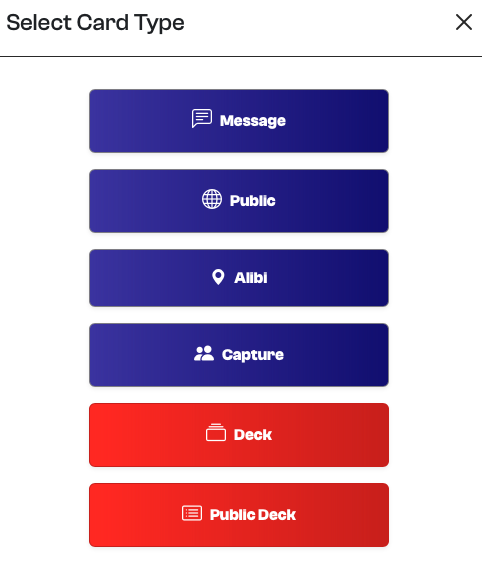
The Alibi Card provides the same basic content capabilities as other AppKeyId Cards while adding the ability to create an authenticated record of the recipient's location and time when the Card is acknowledged.
Step 2 — Write the Alibi Message
Enter a Title and write the Alibi instructions or other information that you want the recipient to acknowledge.
For example:
This is Richard's Alibi Card. Acknowledge it to create an Alibi at a moment in time and at a location
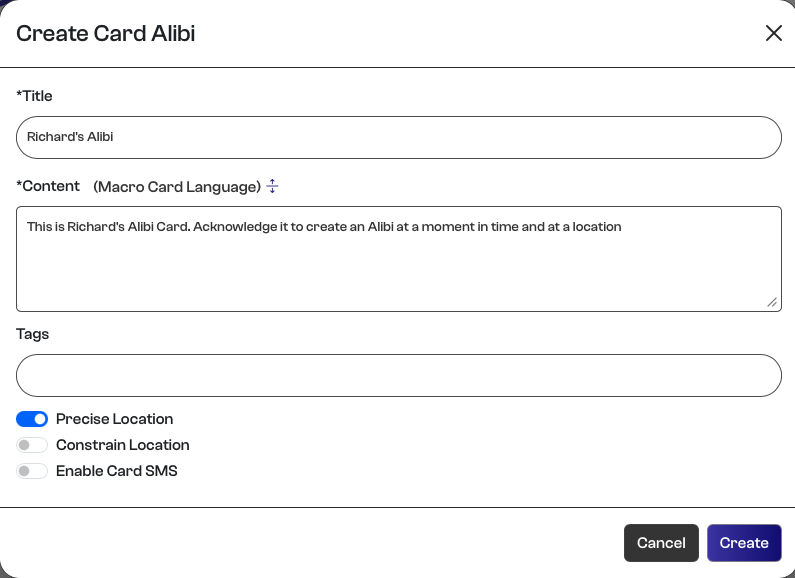
Save the Card when finished.
Step 3 — Share the Alibi Card
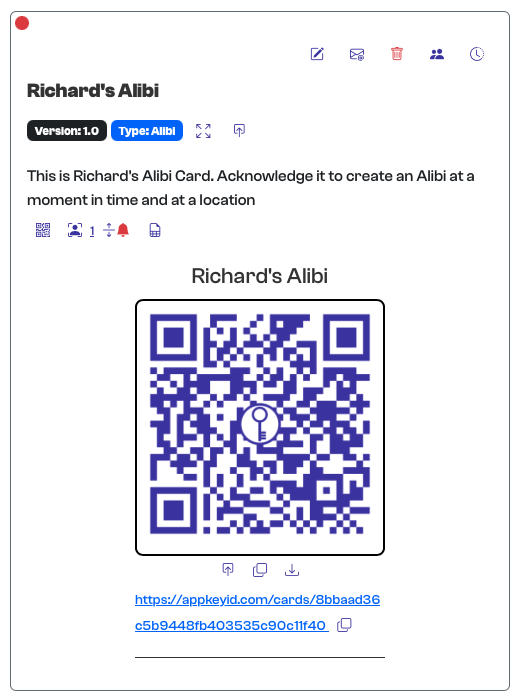
Use Edit Members to share the Alibi Card with the intended recipient. For this example, share the Card with yourself so that you can test the complete Alibi process.
Once shared, copy the Alibi Link or display the Card's QR code.
The link can be sent electronically, while the QR code can be displayed on another screen, downloaded, or printed for scanning with a mobile phone.
Step 4 — Consume and Acknowledge the Alibi
Open the Alibi Card by either:
-
Clicking the Alibi Link, or
-
Scanning the QR code with a mobile phone camera.
The recipient then acknowledges the Alibi Card using their passkey. When Precise Location is enabled and location permission has been granted, AppKeyId records the precise latitude and longitude reported by the device together with the exact time of the acknowledgement.
The resulting Alibi record ties together:
Authenticated User + Biometrically Verified Passkey + Exact Time + Precise Location + Alibi Card
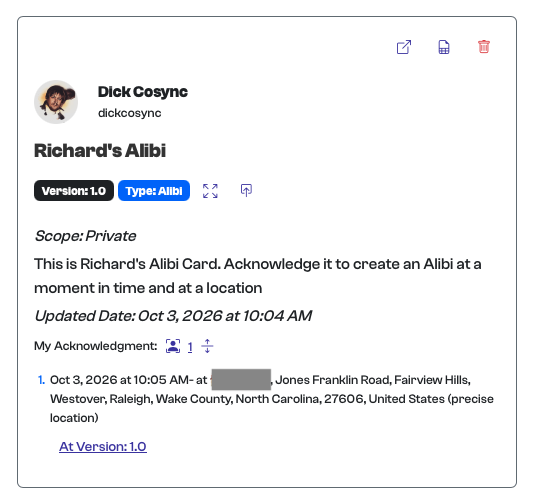
The important point is that the Alibi is created at the moment the Card is acknowledged. The resulting record establishes that the intended recipient's passkey was used to acknowledge that specific Alibi Card at a specific time and from a specific reported location.